We work with organizations across the UAE to design, implement, and optimize ERP systems that unify business processes, enforce control, and deliver real-time operational intelligence.
This guide explains ERP from a technical, architectural, and business perspective, answering the most common and complex ERP queries raised by decision-makers.
What Is an ERP System from a Technical Standpoint?
An Enterprise Resource Planning (ERP) system is an integrated, modular enterprise platform built on a single transactional database and governed by role-based access control (RBAC).
ERP enables:
- Centralized data governance
- Cross-functional process orchestration
- Transaction-level traceability
- Real-time analytics and reporting
From a system architecture view, ERP acts as the core transactional layer between business operations and enterprise analytics.
Core ERP Architecture Explained
1. Application Layer
Handles business logic such as:
- Accounting rules
- Inventory valuation methods
- Project cost allocation
- Payroll calculations
2. Data Layer
- Single source of truth (relational database)
- ACID-compliant transactions
- Master data management (MDM)
3. Integration Layer
- REST / API endpoints
- Third-party system connectors
- Banking, payment gateways, and government portals
4. Presentation Layer
- Web-based user interface
- Role-specific dashboards
- Mobile access (where applicable)
ERP Deployment Models Used in the UAE
Cloud ERP
- Hosted on secure regional or global data centers
- Subscription-based cost model
- Automatic upgrades and scalability
On-Premise ERP
- Deployed on internal infrastructure
- Full control over data and security policies
Hybrid ERP
- Combines cloud flexibility with on-premise controls
- Common in regulated or multi-entity organizations
We implement ERP systems across Dubai, Abu Dhabi, Sharjah, Ajman, Ras Al Khaimah, Fujairah, and Umm Al Quwain, adapting deployment models to regulatory and operational needs.
ERP Functional Modules (Technical Scope)
Finance & Accounting
- General Ledger (multi-currency, multi-company)
- Accounts Payable & Receivable
- Budgeting & cost centers
- Financial consolidation
- Audit trails & compliance
Human Capital Management (HCM)
- Payroll engines
- Attendance & shift management
- Leave policies
- Employee lifecycle tracking
Inventory & Warehouse Management
- FIFO / LIFO / Weighted Average valuation
- Batch & serial tracking
- Multi-warehouse & bin locations
- Stock aging analysis
Procurement & Supply Chain
- Vendor master data
- RFQ & purchase workflows
- Approval hierarchies
- Lead-time optimization
Sales & CRM
- Quotation-to-cash lifecycle
- Credit limits
- Customer analytics
- Pricing rules
Project Management & Job Costing
- Work Breakdown Structure (WBS)
- Budget vs actual tracking
- Cost variance analysis
- Progress billing
- Revenue recognition
Manufacturing & MRP
- Bill of Materials (BOM)
- Routing & capacity planning
- Production scheduling
- Work-in-progress (WIP)
ERP for Industry-Specific Operations in the UAE
Construction & Contracting
- Project-based accounting
- Retention management
- Cost-to-complete forecasting
Manufacturing & Industrial
- MRP-driven procurement
- Quality inspections
- Production cost absorption
Trading & Distribution
- Demand planning
- Inventory optimization
- Multi-branch operations
Professional Services
- Resource utilization
- Time-based billing
- Margin analysis
ERP Implementation Methodology
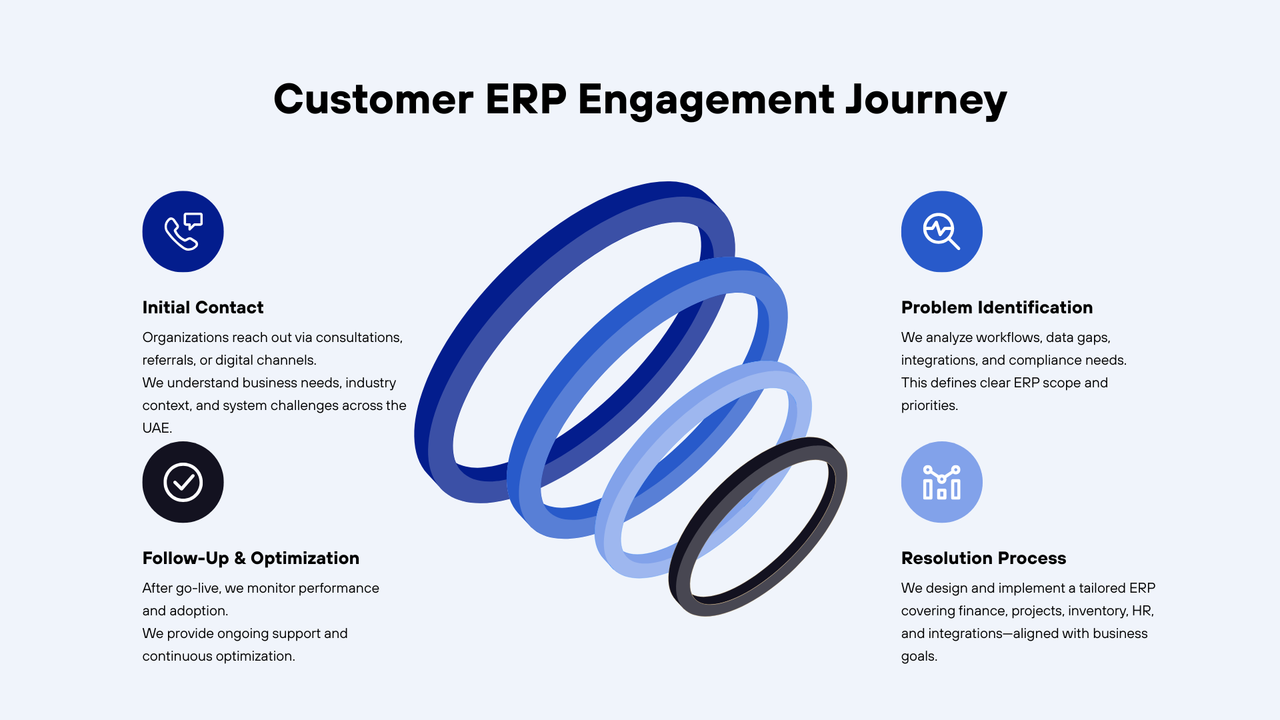
Our ERP implementation follows a controlled, phased approach:
1: Discovery & Process Mapping
- As-is vs To-be analysis
- Business pain point identification
- Compliance and reporting needs
2: Solution Design
- Module selection
- Chart of accounts structuring
- Workflow & approval logic
3: Configuration & Customization
- Business rules configuration
- Reports and dashboards
- API integrations
4: Data Migration
- Master data validation
- Historical transaction cleansing
- Migration testing
5: User Training & Go-Live
- Role-based training
- Parallel run validation
- Controlled production release
ERP Security, Compliance & Governance
ERP systems enforce:
- Role-based access control (RBAC)
- Audit logging
- Segregation of duties (SoD)
- Data encryption (at rest & in transit)
These controls are critical for UAE businesses operating under:
- VAT regulations
- Corporate governance frameworks
- Multi-entity financial structures
ERP Reporting & Analytics
ERP provides:
- Real-time financial statements
- Operational dashboards
- Cost and margin analysis
- Predictive planning inputs
Data from ERP becomes the foundation for:
- BI tools
- Management reporting
- Strategic forecasting
Common ERP Challenges We Address
- Fragmented legacy systems
- Spreadsheet dependency
- Poor data visibility
- Uncontrolled project costs
- Inefficient approval cycles
ERP replaces disconnected tools with structured, governed workflows.
ERP Selection Criteria for UAE Businesses
We evaluate ERP solutions based on:
- Industry alignment
- Scalability
- Localization & tax compliance
- Integration capability
- Long-term maintainability
Final Perspective
ERP is not an IT upgrade.
It is an enterprise operating system.
When implemented correctly, ERP delivers:
- Financial control
- Operational transparency
- Predictable scalability
We help organizations across the UAE transform complexity into structured, data-driven operations.
669 words · 3 min read